Search guide
How do I find solar leads in England and Wales?
Updated · 8 minutes read
By EcoBrace
Looking for homes with no solar panels, don't rely on the EPC alone to tell you which ones they are. An EPC records the roof on the day it was assessed, lasts 10 years and is only needed when a home is sold, let or built, so a home that fitted panels after its last EPC can still appear as having none on the EPC. EcoBrace finds homes with no solar panels, even where the EPC is out of date or completely missing, so your list doesn't rely on a certificate that may be years old.
Why do installers use EPC data to find solar leads?
Because it’s the only public dataset that says, house by house, whether an assessor found solar panels on the roof. Every domestic Energy Performance Certificate in England and Wales carries a field called PHOTO_SUPPLY. MHCLG’s data dictionary defines it as “whether the property generates electricity from solar panels. The proportion of the roof area (%) covered by solar panels is assessed. 0% means that the property does not have solar panels” (MHCLG, domestic EPC data dictionary, read 11 October 2026).
Most installers use it the same way: take a postcode district, keep the certificates that read 0%, and write to or knock on those doors. The same certificate also tells you the energy rating, the main heating fuel and whether the home is owner-occupied, which helps you decide who gets a letter first.
The catch is in two other fields from the same dictionary. INSPECTION_DATE is “the date when information about the building was collected to prepare the EPC”, and TRANSACTION_TYPE “states why the energy certificate was produced”, such as a sale, a rental or a new build. Everything on the certificate, solar field included, describes the home on that inspection date. And none of the usual reasons for getting one has anything to do with solar.
Why EPC is not a reliable guide to which homes have no solar panels?
Because the EPC certificate stands still while the roof changes. GOV.UK says “you must have an EPC” when you’re selling a property, renting one out or building a new one, and that a certificate “is valid for 10 years” (GOV.UK, Energy Performance Certificates, read 11 October 2026). That leaves four ways the solar field in an EPC goes wrong:
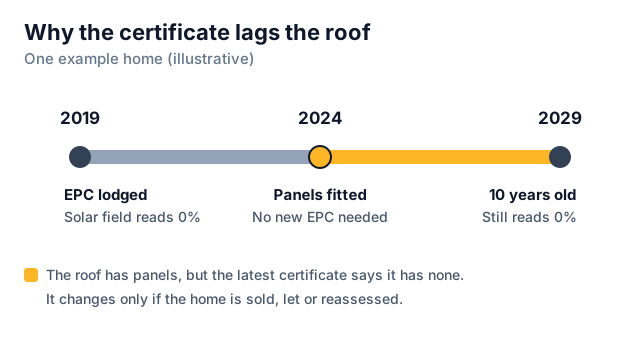
- The certificate predates the panels. A home assessed in 2019 and fitted with panels in 2024 still reads 0% on its latest certificate. Nothing in the process updates it.
- Nobody has had a reason to replace it. A new certificate usually arrives only when the home is sold or let. An owner who stays put after fitting panels has no reason to commission one.
- Old certificates stay in the data. The open data “includes certificates registered since 2012, which may have expired or been replaced” (MHCLG, Get energy performance of buildings data, read 11 October 2026). If a list is built from every certificate rather than the latest one for each address, an older 0% can outvote a newer reading.
- Some homes have no EPC certificate at all. If a home hasn’t been sold, let or built since 2012, the open data usually has nothing to say about its roof.
The register is doing its job here. A certificate describes the home when it’s sold, let or built, so its solar field shows the roof as it was on that day and no later.
How many homes have solar panels fitted since their last EPC?
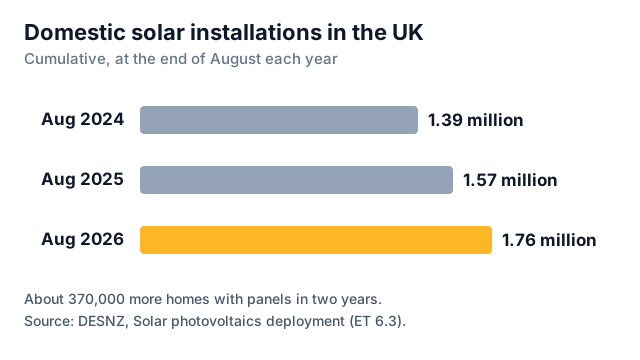
Nobody publishes that figure, but the public numbers show how quickly the gap grows. DESNZ’s solar deployment tables count 1,761,110 domestic solar installations in the UK at the end of August 2026, up from 1,565,543 a year earlier and 1,391,337 two years earlier. DESNZ also says there “have been 291,000 installations in the past year- the most in any 12 month period since 2012”, counting all sizes (DESNZ, Solar photovoltaics deployment, ET 6.3, September 2026 publication, data to August 2026, read 11 October 2026). By our arithmetic, that’s about 195,600 more homes with panels in twelve months, and about 370,000 in two years.
Set that against how few homes get a new certificate. MHCLG’s statistics say that “in the 12 months to June 2026, 1,388,000 EPCs for existing dwellings were lodged on the register in England”, and 80,000 in Wales (MHCLG, EPC statistics, April to June 2026, published 30 July 2026, read 11 October 2026). England has “25.8 million dwellings … as of 31 March 2025” (MHCLG, Dwelling stock estimates, read 11 October 2026). On our arithmetic again, that’s roughly one new certificate for every 19 existing homes in a year.
So a home that fits panels this year will usually keep the certificate it already had. If the roof was bare when that certificate was done, it still says 0%. The two sets of figures don’t cover exactly the same ground (DESNZ counts the UK, the certificate figures are for England and Wales), so treat them as a sense of scale, not a measured error rate.
What about homes that have no EPC at all?
A home only gets a certificate when something triggers one, and the people least likely to trigger one are those who stay put. The English Housing Survey found that “owner occupiers lived in their current home for the longest, an average of 17.0 years”, and that “outright owners lived in their property for an average of 23.7 years” (English Housing Survey 2024 to 2025, chapter 3, read 11 October 2026). Both averages are longer than a certificate’s ten-year life.
That matters for solar in two ways. Some of these homes have no certificate in the open data, so an EPC-only list leaves them out completely, whether or not they have panels. Others have a certificate from well over a decade ago that still sits in the data. The open data also covers England and Wales only, because Scotland keeps a separate register.
Is there a public list of homes with solar panels?
No public dataset lists them address by address. DESNZ publishes domestic installation counts by parliamentary constituency in Table 3 of its solar deployment tables (DESNZ, ET 6.3, read 11 October 2026). That’s useful for judging how crowded an area already is, but it doesn’t tell you which houses to write to.
You can look up a single property’s certificate on GOV.UK’s Find an energy certificate service (read 11 October 2026). It shows the same solar reading the open data holds, with the same age problem, one address at a time. That’s fine for checking a lead before a visit, and too slow for building a list. If you do build a list from EPC data, read the register’s licensing page first, because it licenses the address fields differently from the rest of the certificate.
How does EcoBrace help finding homes without solar panels?
Run a search for a postcode district or a full postcode, and EcoBrace will identify the homes in it with no solar panels detected, even where the EPC is out of date or missing. The list doesn’t depend on the certificate’s solar field alone, so a home that fitted panels after its last EPC isn’t kept on the list just because its certificate still says 0%. We don’t name the imagery sources it uses.
You still get the EPC detail alongside each home, where a certificate exists: the energy rating, the main fuel, tenure and the rest. So you can narrow the list the same way you would with EPC data, for example to owner-occupied homes, or to electrically heated homes where panels would offset the most bought-in electricity. Then export it to Excel (a paid-account feature) or send it straight to a Direct Mail campaign.
A few limits to bear in mind:
- Detected isn’t the same as surveyed. Treat a home on the list as a prospect to check, confirm the roof when you visit, and don’t tell a homeowner in writing that their roof has no panels.
- It says nothing about the occupier. It doesn’t tell you who lives there, whether they own the roof or whether they want solar.
- Costs are shown first. A full-postcode search with no extra data is free. A district search, and any extra data you add, is charged on what’s actually searched, and you see a maximum estimate before you run it.
- England and Wales. Pay-as-you-go district search isn’t available in Scotland.
How should I approach the leads once I have a list of homes without solar panels?
Write before you call. The ICO says that “direct marketing by post is not covered by PECR. But you must still comply with data protection law, if you are using personal information as part of your campaign” (ICO, Plan direct marketing, read 11 October 2026). Phone and email are much tighter: automated calls and most marketing email to individuals need prior consent, and live calls have to be screened against the Telephone Preference Service.
Then there’s the letter itself. Talk about the street, not the house: something like “most homes on this road don’t have panels yet” is fair, but “we noticed your roof has no panels” reads as surveillance, and it could be wrong. Make one offer, back up any savings figure you print, and give one way to reply. How do I use direct mail to find solar leads? covers the letter, the advertising rules and what a cold letter usually returns. This is marketing guidance, not legal advice, so check the ICO’s pages against your own campaign.
What does this guide not cover?
It doesn’t tell a homeowner whether solar suits their roof, and it doesn’t estimate how many panels a roof will take or what they’ll generate. It isn’t legal advice on marketing or data law either. Read the ICO’s guidance and the EPC register’s licensing page against your own plans. It also gives no figure for how many EPCs are out of date, because nobody has published a measured one.
Where do I start?
Pick one postcode district you can cover, and treat the first list as a test. Sign up and run a search. There’s no subscription and no minimum order, and a full-postcode search with no extra data is free. If you’d rather talk it through first, contact us at hello@ecobrace.co.uk about which districts to start with and how to turn the list into letters, or ask about Scout, the guided version of Direct Mail, where we keep your monthly list full for you.
Key takeaways
- Every domestic EPC has a field for the share of the roof covered by solar panels, which is a good place to start.
- Installing solar panels does not require a new EPC certificate to be lodged.
- Hundreds of thousands of homes add solar panels each year, while only a small share of homes get a new EPC certificate, so the data gap keeps growing.
- Homes with no EPC certificate at all are often long-standing owner-occupiers, and the open data says nothing about their roofs.
- EcoBrace finds homes with no solar panels even where the EPC is out of date or missing; treat it as a starting point and confirm each roof at survey.
People also ask
- Does an EPC show whether a house has solar panels?
- Yes, as of the day it was assessed. The certificate records the proportion of the roof covered by solar panels, and 0% means the assessor found none. It doesn't change when panels are fitted later, so an old certificate can say 0% on a house that now has them.
- Does fitting solar panels mean a home needs a new EPC?
- No. You need an EPC when you sell a property, rent one out or build one. Fitting panels isn't on that list, so most homes keep the certificate they already had until the next sale, letting or voluntary reassessment.
- How long is an EPC valid for?
- Ten years. A certificate can stay valid for most of that time on a home whose roof has changed since, and the open data keeps older certificates too, including ones that have expired or been replaced.
- How accurate is EcoBrace's solar detection?
- About 95% accurate. EcoBrace checks roofs against satellite imagery from several sources, so accuracy depends on how recent the imagery is for an area. Confirm each roof when you visit or survey.
Sources
- MHCLG — Get energy performance of buildings data
- MHCLG — domestic EPC data dictionary
- GOV.UK — Energy Performance Certificates
- MHCLG — EPC statistics, April to June 2026
- MHCLG — Dwelling stock estimates, England: 31 March 2025
- DESNZ — Solar photovoltaics deployment (ET 6.3)
- English Housing Survey 2024 to 2025 — housing history
- GOV.UK — Find an energy certificate
- ICO — Plan direct marketing