Direct Mail guide
How do I find heat pump leads with direct mail?
Updated · 15 minutes read
By EcoBrace
Write to the kinds of home the scheme's own figures show are switching. Most grant-funded heat pumps replace gas, followed by oil, homes with no previous heating system, and direct electric. Build the list from EPC fields such as main fuel, mains gas, main heating, built form, floor area and tenure, and post your letter to those doors only. Cold letters get around a 1% measured response on average across sectors, so you'll need hundreds of letters for each install. Make one qualified, grant-led offer with your MCS number on it, give every campaign its own reply code, and check the sums against your margin before you scale up.
Is the Boiler Upgrade Scheme still worth building a mailing campaign around?
Yes. The scheme is bigger, runs for longer and is simpler to qualify for than at any point since it opened. GOV.UK lists £7,500 towards an air source (air-to-water) or ground source heat pump, and Ofgem’s scheme page says eligible off-gas-grid properties get £9,000 towards an air-to-water or ground source heat pump, “available until 31 March 2027” (GOV.UK, what you can get; Ofgem, Boiler Upgrade Scheme, both read 25 September 2026).
The amending regulations that came into force on 28 April 2026 made three changes that matter if you’re mailing homeowners. They “extend the operation of the BUS through to 2030”, they “remove the requirement for a property to have a valid energy performance certificate”, and they define the installer as a person certified by the Microgeneration Certification Scheme (SI 2026/390, explanatory note, read 25 September 2026). You run the application. You apply on the owner’s behalf, Ofgem emails the owner to confirm consent, and since April 2026 you have to deduct the grant from the upfront cost (Ofgem, installers; the scheme background in DESNZ’s statistics, both read 25 September 2026).
Demand is rising too. DESNZ’s August 2026 statistics, published on 24 September 2026, count 151,136 voucher applications since launch. Of those, 7,486 came in August alone, the second-highest month on record and 120% up on August 2025. The 5,903 vouchers issued that month were the most ever, and 43% of them were for the uplifted off-grid grant (DESNZ, Boiler Upgrade Scheme statistics: August 2026, read 25 September 2026). The scheme covers England and Wales only, and Scotland runs its own.
Which homes are actually switching to heat pumps?
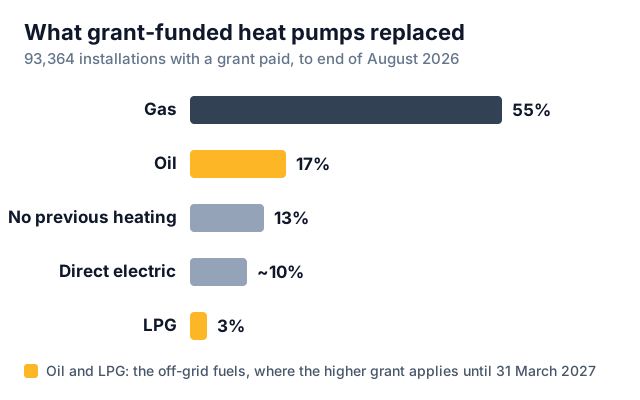
Mostly gas homes, and that’s the first thing a heat pump mailing list tends to get wrong. DESNZ counts 93,364 installations with a grant paid to the end of August 2026. Its table of fuel displaced shows that 55% of them replaced gas, 17% oil, 13% homes with no previous heating system, about 10% direct electric and 3% LPG. Of the same homes, 62% were on the gas grid, and urban and rural properties split almost evenly, 51% to 49% (DESNZ, Boiler Upgrade Scheme statistics: August 2026, tables 1.3, 1.5 and 1.6, read 25 September 2026).
Off-grid oil and LPG homes get the higher grant and face a hard deadline, so they make the sharpest list. They’re still a minority of the homes the scheme pays for. Few installers write to direct-electric homes, and those homes qualify at the standard rate: GOV.UK’s eligibility page says the scheme covers “replacing fossil fuel heating systems - such as oil, gas, electric or LPG” (GOV.UK, check if you’re eligible, read 25 September 2026).
When you write matters as much as who you write to. Research for DESNZ published on 24 September 2026 sorts the moments when people act into five trigger points: “emergencies (for example, a boiler breaking down …)”, “life stages or events (for example, moving home, retirement)”, social influences such as professional advice, the cost of energy, and “quality of the living environment (for example, home renovations)” (DESNZ, Trigger points, read 25 September 2026). A letter can’t tell whose boiler has just broken. It can reach people who have just bought a house, though, and it can arrive before the heating season starts.
Which EPC fields tell me a home is a heat pump prospect?
Six fields do most of the work, and the domestic Energy Performance Certificate records each of them for every property in England and Wales. The definitions in the table are quoted from MHCLG’s domestic data dictionary (MHCLG, domestic EPC data dictionary, read 25 September 2026). The use it to column is our own method; the register doesn’t suggest these uses.
The mains-gas flag needs care. It records “a capped, disconnected, or unused gas supply (even if a meter is present)” as No, but Ofgem treats a capped or clamped meter point as still fuelled by mains gas for the off-grid grant. So an EPC that says no mains gas is a reason to write to the home, not proof that it gets the higher grant. Our off-gas-grid guide covers that test in full, along with the two other public sources of off-grid data. Every field describes the home as it was on the certificate’s assessment date. The open data covers certificates registered since 2012, and Scotland’s register is separate and isn’t included.
| EPC field | What the register says it records | Use it to |
|---|---|---|
| Main fuel | ”The fuel used to power the property’s main heating system — for example, mains gas, electricity, heating oil, or solid fuels.” | Split the list into oil and LPG, electric, and gas segments, each with its own letter. |
| Mains gas flag | Whether “mains gas is actively used in the property”; a capped or unused supply is a No. | Find homes with no active gas, then check the meter-point position at survey. |
| Main heating description | The main heating system, “such as a gas boiler with radiators, electric storage heaters, or a heat pump”. | Take out homes that already have a heat pump (the grant can’t replace low-carbon heating) and find storage-heater homes. |
| Property type and built form | House, flat or maisonette; “detached, semi-detached, terraced, or part of a block”. | Lead with houses, and treat flats as a separate, harder conversation. |
| Total floor area | ”The total enclosed floor area of the property … in square metres.” | Put larger homes first, since they have the biggest heating bills and the strongest case for changing. |
| Tenure | ”One of: owner-occupied; rented (social); rented (private)”. Self-declared, and not part of the rating. | Keep owner-occupied homes. Social housing is outside the scheme. |
How do I turn those fields into a mailing list?
Start with a postcode district you can survey in a day, and split it into three or four segments instead of mailing one big list, because each segment needs its own letter. A sensible first pass has three. Oil and LPG homes with no mains gas get the uplifted-grant letter, with its March 2027 date. Electrically heated and storage-heater homes get the standard grant and a case built on replacing the most expensive heating to run, made without any savings figure you can’t back up. Gas-heated houses make up the biggest pool and also get the standard grant; start with detached and semi-detached houses and the larger floor areas. In every segment, take out homes whose main heating already reads heat pump, keep owner-occupied tenure, and dedupe by property so that a home with several certificates gets one letter.
Two more lists are worth a small test each. Homes with no certificate at all have been able to apply without one since 28 April 2026, using alternative evidence, so a missing EPC no longer rules a home out. Recent buyers are worth trying because moving home is one of DESNZ’s named trigger points, and a sold date narrows the list down to them. All of this is our method rather than a rule from any scheme document. The certificate cuts down the driving, and the survey confirms each house. Before you build a list, read the EPC register’s licensing page. It sets out what the address fields may be used for, and it licenses them differently from the rest of the certificate.
What should a heat pump letter say?
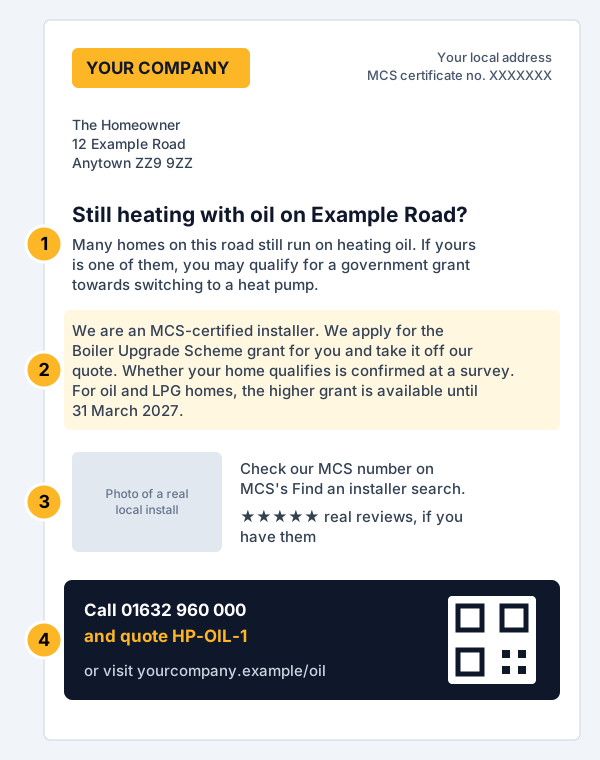
Four things, in this order: why you’re writing to this street, the offer with the grant properly qualified, why they can trust you, and one way to reply.
For the street, say something true about the area, such as that many nearby homes still heat with oil or were built before cavity walls. Don’t imply that you’ve inspected the reader’s house. The offer names the grant, says you’re the MCS-certified installer who applies for it and deducts it from your quote, and says eligibility is confirmed at a survey. An oil or LPG letter should also give the scheme’s own end date for the uplift. For trust, give your MCS certification number, which the reader can check on MCS’s public Find an installer search (read 25 September 2026). Add a local address and, if you have them, real reviews and a photo of a real install. Then give one way to reply: a single phone number, web address or QR code.
The CAP Code sets out what the letter mustn’t do, and the duty to comply sits with you as the installer. Rule 3.7 requires you to “hold documentary evidence to prove claims that consumers are likely to regard as objective”. Rule 3.23 bars calling anything “free” if the consumer pays anything beyond the unavoidable cost of responding. Rule 2.1 says marketing “must be obviously identifiable as such” (CAP Code section 3 and section 2, read 25 September 2026). A letter dressed up as a government or scheme notice is therefore a problem under the code. It’s also a trust risk in a category that homeowners already associate with grant scams. CAP’s April 2026 advice on greener-homes claims adds two points. “Up to” savings claims need evidence “that a significant proportion of customers can actually achieve the maximum saving”, and you must “make clear … if a government grant has already been applied” to any price you show (ASA/CAP, 9 April 2026, read 25 September 2026). Our solar direct-mail guide applies the same rules to a solar letter.
How do I know which letters worked?
Give every campaign, and every segment within it, its own reply route, and ask everyone who gets in touch how they heard about you. The cheapest options are a short web address or QR code for each segment that leads to a page only that letter points to, a campaign code the reader quotes (“quote HP-OIL-1 for your survey”), or a separate phone number for each campaign. That way a reply from an oil home and a reply from a gas home arrive already labelled.
Log each reply against its segment as it comes in, and follow it through from enquiry to survey booked, quote sent and signed. The segment that brings in the most calls isn’t always the one that brings in the most installs. JICMAIL builds the benchmarks in this guide from measured response in the same way. Its tracker records campaigns “measured through matchback, unique tracking code and test and control techniques” (JICMAIL, Response Rate Tracker 2026, master results, read 25 September 2026), which makes its figures more reliable than a number somebody remembers. Posting confirms that a letter was despatched, not that it was delivered or read, so the only response data you’ll ever have is the replies you tagged yourself.
When should I send, and how often should I follow up?
Send off-grid letters now, and plan the rest around the heating season and a second wave. Ofgem’s page says the uplifted grant for oil and LPG homes is available until 31 March 2027, and DESNZ’s scheme background says air-to-water vouchers are valid for three months and ground source vouchers for six (DESNZ, Boiler Upgrade Scheme statistics: August 2026, scheme background, read 25 September 2026). A reply that arrives in February leaves very little time for the survey, design, application and installation. Check Ofgem’s current installer guidance before you promise anyone the higher grant late in the window.
For gas and electric homes the scheme now runs to 2030, so there’s no deadline to work to. A breakdown is a trigger point, though, and breakdowns tend to come when people turn the heating on. A letter that lands in early autumn reaches the house before the emergency instead of after it (this is our reasoning, not a measured finding).
Send a second letter to the same list three to four weeks after the first, with a different opening and the same offer, and leave out anyone who has replied or asked you to stop. That interval is a common convention rather than a published benchmark. JICMAIL’s 2026 tracker found that campaigns with both a brand and a response objective reach “up to five times higher response rates”, and that A4 mailers generate “around 2.7 times” the response of postcards (JICMAIL, Response Rate Tracker 2026, read 25 September 2026). Both findings favour a letter that clearly comes from the same local firm each time over a one-off postcard.
How many letters does it take to win one heat pump install?
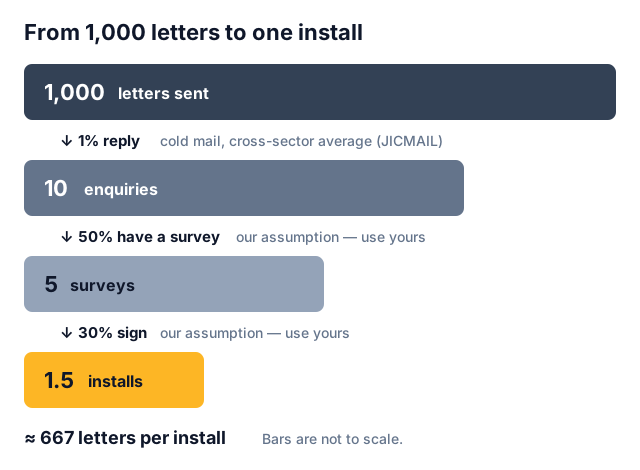
Several hundred at cross-sector response rates, and you can work out your own figure with three multiplications. JICMAIL’s tracker, built from 4,939 measured campaigns, puts cold direct mail at a 1% response averaged across 2023 to 2025, and warm mail to existing customers at 6.3%. Both rose by over 20% in 2025. The tracker only publishes a figure for a sector where it has at least ten campaigns, and it has no row for heat pumps, energy or home improvement (JICMAIL, Response Rate Tracker 2026, master results, read 25 September 2026). Use 1% as a starting assumption until you have figures of your own.
The worked example below adds two steps: half of enquiries become a survey, and three in ten surveys sign. Both rates are our assumption, so replace them with your own conversion figures. At those rates one install takes about 667 letters. A letter therefore pays for itself as long as its all-in cost (list, print, postage and your time on the replies) stays below your gross margin on one install divided by 667.
One campaign is a small sample. Ten expected enquiries could as easily arrive as six or fourteen, so judge the channel over several campaigns. Your past customers are also your warm list, and the tracker’s warm figure is several times its cold one, so write to them about a heat pump before you write to strangers.
| Step | Assumption | Source | 1,000 letters produce |
|---|---|---|---|
| Reply | 1% of letters | JICMAIL cold direct mail, cross-sector average (no heat pump row exists) | 10 enquiries |
| Survey | 50% of enquiries | Our assumption: replace with yours | 5 surveys |
| Sign | 30% of surveys | Our assumption: replace with yours | 1.5 installs |
| Letters per install | 1 ÷ (1% × 50% × 30%) | Arithmetic | About 667 |
At a 0.5% response the same rates give about 1,333 letters per install, and at 2% they give about 333. With a range that wide, it’s worth tracking by segment from your first campaign.
What are the rules on writing to homeowners?
Post is the one cold channel into a household that the electronic-marketing rules don’t cover. The ICO’s direct-marketing guidance says that “direct marketing by post is not covered by PECR. But you must still comply with data protection law, if you are using personal information as part of your campaign” (ICO, Plan direct marketing, read 25 September 2026). If you put a name on the letter, you need a lawful basis for using it, and legitimate interests is one the guidance discusses for postal marketing. Unless you hold a name from a lawful source, address the letter to the Homeowner.
Two duties apply however you address it. The right to object is absolute: “If someone objects, you must stop using their personal information for direct marketing”, and “there are no reasons that you can use to refuse their objection” (ICO, Respect people’s preferences, read 25 September 2026). Keep a do-not-write list and check every new campaign against it. The ICO also says you “should” check names and addresses against the Mailing Preference Service before a mailing. It’s “not a statutory preference service”, but some industry codes require it.
Phone and email work differently. Under PECR, automated calls and most marketing email to individuals need prior consent, and live calls must be screened against the Telephone Preference Service (ICO, direct marketing and PECR). This is marketing guidance, not legal advice, so read the ICO’s pages against your own campaign.
How do I do this in EcoBrace?
Run a postcode-district search, filter the grid down to one segment, and add it to a Direct Mail campaign. The letter then goes to those doors and nowhere else. Enter a district such as ZZ9 (a made-up one, so pick your own) and EcoBrace fetches the EPC data live from the official register for every certificate in it. The results grid has columns for Main Fuel, Mains Gas, Main Heating, Property Type, Built Form, Floor Area, Tenure, EPC Band, wall and roof insulation and the certificate date. Each segment from the list-building section above is a set of column filters, applied after the search runs.
Two optional enrichments, chosen before the search, give you the two test lists. Missing EPCs returns the addresses with no certificate. Sold history, which is pay-as-you-go and covers England and Wales only, adds the last sale date and price, so you can filter recent buyers by date. You can export a list to Excel (a paid-account feature) or add it straight to a campaign. A campaign’s recipients can only come from a search, up to 1,000 per campaign, and they’re deduplicated by property as they’re added.
Upload your letter as a print-ready PDF; the first document is the one that carries the address. Then pick a window or closed-face envelope, mono or colour, single- or double-sided, first or standard class, and a despatch date. The proof is free. Generating it fixes the price for your exact list, and your wallet is only charged when you press Send. For the second wave, Duplicate Campaign carries over the recipients, envelope and print choices and asks for a fresh proof and price. If anyone has replied or asked you to stop, rebuild the second list from the saved search (kept for 90 days) without them.
A full-postcode search with no extra data is free. A district search is charged on the actual number of postcodes searched, and you see a maximum estimate first. Tracking shows the campaign’s progress and its despatch and estimated delivery dates. It doesn’t show delivery for each letter or any replies, so tagging replies is down to you. Pay-as-you-go district search isn’t available in Scotland, which is outside the grant anyway.
What does this guide not cover?
It doesn’t tell a homeowner whether they qualify for the grant. The installer confirms that at survey, against GOV.UK’s eligibility rules. It isn’t legal advice on marketing law either. Read the ICO’s direct-marketing guidance and the register’s licensing page against your own campaign. The guide also gives no heat pump response rate and no cost per letter. There’s no honest published figure for the first, and EcoBrace shows every price for your exact list before you commit.
Where do I start?
Pick one district, one segment and a few hundred letters, and treat the first campaign as a way to measure what works. Sign up and run a search. A full-postcode search with no extra data is free, and there’s no subscription and no minimum order. If you’d rather talk it through first, contact us at hello@ecobrace.co.uk about which districts to try, what the letter should say, and whether Scout suits the way you sell. Scout is the guided version of Direct Mail, where we learn a property profile from your past sales and keep your monthly list full. If you’d rather buy survey appointments than build your own list, EcoBrace also sells exclusive, phone-qualified appointments to MCS-certified installers in England and Wales. See how that works.
Key takeaways
- The grant has been extended, no longer needs a valid EPC before an application, and is claimed and deducted up front by the MCS-certified installer, so your letter can lead with it as long as you qualify it.
- Most grant-funded heat pumps replace gas boilers. Off-grid oil and LPG homes get the higher uplifted grant for a limited time, and few mailers write to direct-electric homes, a smaller segment.
- The EPC's main fuel, mains gas, main heating, built form, floor area and tenure fields turn a postcode district into a list of doors, but they describe each home as it was when assessed.
- Under the advertising code it's the installer's duty to send a letter that explains why this street, makes one qualified offer, shows the MCS number and is plainly marketing rather than an official-looking notice.
- At typical cold-mail response rates one install takes hundreds of letters, so a single campaign is too small a sample to judge the channel on.
People also ask
- Does a home need an EPC before I can apply for the heat pump grant?
- Not any more. Since 28 April 2026 a valid Energy Performance Certificate is no longer a condition of an eligible property. If the home has a valid certificate, you give its number with the application. If it doesn't, you provide alternative evidence instead. Homes without a certificate are still grant prospects, and they're worth a list of their own.
- Can my letter say the heat pump is free?
- Only if the homeowner would pay nothing beyond the unavoidable cost of responding, and that's rarely true of an installation. The advertising code bars calling a product free when the consumer has to pay anything else, and the regulator's April 2026 advice says you should make clear when a grant has already been applied to a price you show. Say what the grant is, that you deduct it from the quote, and that eligibility is confirmed at survey.
- What response rate should I expect from a heat pump letter?
- Nobody has published one. JICMAIL's tracker puts cold direct mail at around 1% averaged across sectors, but it only prints a sector benchmark where it has at least ten campaigns, and it has no row for heat pumps, energy or home improvement. Plan on the cross-sector figure, measure your own with a reply code for each campaign, and judge the channel over several campaigns rather than one.
- Should I write to rented homes?
- Usually not with a homeowner letter, because a letter posted to the address reaches the tenant rather than the owner. The certificate's tenure field is self-declared and can be out of date, so it will remove most rented homes from your list but can't guarantee to remove them all.
Sources
- Ofgem — Boiler Upgrade Scheme
- Ofgem — Boiler Upgrade Scheme, Installers
- GOV.UK — Apply for the Boiler Upgrade Scheme
- SI 2026/390 — The Boiler Upgrade Scheme (England and Wales) (Amendment) Regulations 2026
- DESNZ — Boiler Upgrade Scheme statistics: August 2026
- DESNZ — Trigger points for installing low carbon heating and energy efficiency measures
- MHCLG — Get energy performance of buildings data
- JICMAIL — Response Rate Tracker
- ICO — Direct marketing guidance
- CAP Code (ASA)
- ASA/CAP — greener homes savings claims
- MCS — Find an installer
Contains HM Land Registry data © Crown copyright and database right 2026. This data is licensed under the Open Government Licence v3.0.